
Budongo Forest Reserve Uganda
Other Primates at Budongo Forest
Budongo Forest Reserve is known for offering Chimpanzee Trekking adventures to travelers although the reserve offers views of other primates as travelers transfer from one point to another.
The Forest inhabits nine different primate species making it one of Uganda’s most important sites for primate conservation and research.
1. Black and White Colobus Monkeys
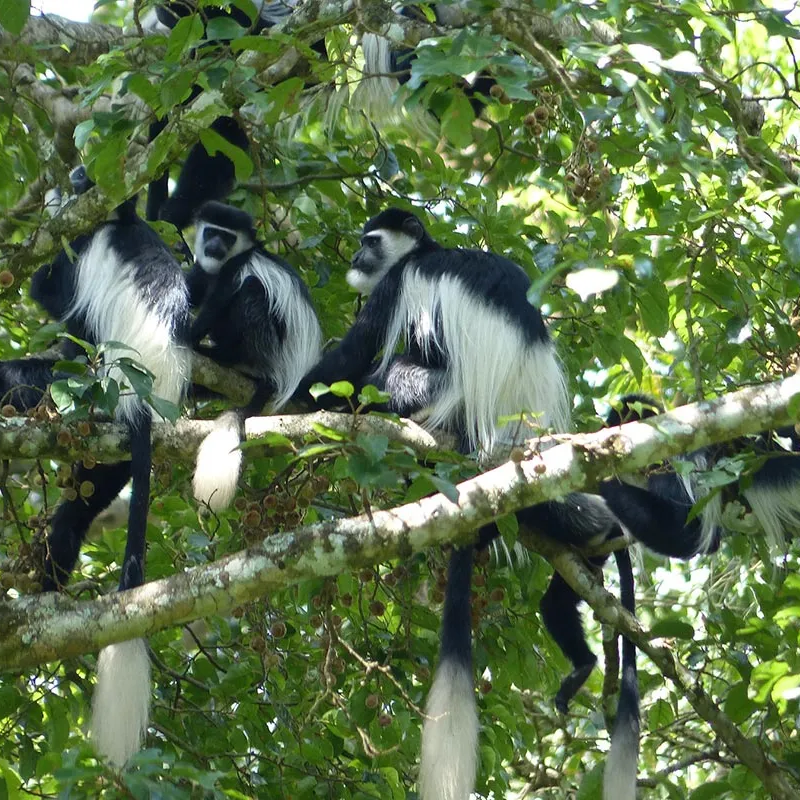
The black-and-white colobus is one of the most exceptional attractions in the forest reserve. This is characterized with a glossy black body, long white mantle and a unique white tail tuft.
These monkeys spend most of their lives in the forest canopy and feed initially on leaves, making them important in the ecosystem. They are Highly arboreal (tree-dwelling), Leaf-eating specialists, Live in social groups, excellent leapers between trees.
2. Grey-cheeked Mangabey
Grey-cheeked Mangabey are one of Budongo’s most charismatic monkeys comprising of dark fur, pale cheeks and expressive face. It is highly active and often moves through the forest in noisy groups. Mangabeys are important seed dispersers because they consume many fruits and carry seeds throughout the forest. Their movements help regenerate forest vegetation.
4. Red-tailed Monkey
The red-tailed monkey is one of the most common monkeys in Budongo Forest Reserve and are identified by their reddish tail and white nose markings.
These agile monkeys spend most of their time in the middle and upper forest canopy feeding on fruits, flowers and insects. Red-tailed monkeys often form mixed-species associations with blue monkeys, helping both species detect predators more effectively.
5. Blue Monkey
Despite its name, the blue monkey appears greyish-blue rather than bright blue. It inhabits dense forest canopies and feeds mainly on fruits, leaves, and insects. Blue monkeys are known for their alert behavior and complex vocal communications. They have amazing capabilities which include; strong climbing techniques, Excellent vision in dense forests, Flexible diet that changes with seasonal food availability.
6. Olive Baboon
Olive Baboons at Budongo Forest reserve spend almost all their time on the ground and are highly adaptable omnivores which can be found close to the forest edges, roads and clearings. Olive baboons live in large troops with complex hierarchies and social relationships. They feed on fruits, seeds, roots, insects, and occasionally small animals.
7. Vervet Monkey
The vervet monkey is less common in the interior forest but may be encountered along forest edges and adjacent woodland habitats. These monkeys are known for their intelligence, social behavior and sophisticated alarm calls. Researchers have found that vervets use different alarm calls for different predators, such as eagles, snakes and leopards.
8. Potto
The potto is a nocturnal primate rarely seen during daytime. It moves slowly and deliberately through the trees at night while feeding on fruits, insects, and tree gums. It has large eyes for night vision, Strong grip for climbing, slow movements that help avoid detection by predators.
9. Bushbaby (Galago)
Bushbabies also known as galagos, are candid nocturnal primates famous for their enormous eyes and powerful jumping ability. Their calls are often heard at night around forest camps and lodges. It comprises of unique features i.e they can leap many meters between branches, excellent night vision, feed on insects, fruits and tree gums.
Best Locations to See Primates in Budongo Forest
The best locations for primate viewing in Budongo forest reserve include:
Kaniyo Pabidi – excellent for chimpanzees, blue monkeys, and colobus monkeys.
Royal Mile – renowned for birding but also productive for monkey sightings.
Sonso – research area where chimpanzees and several monkey species are frequently observed.
About Budongo Forest
Budongo Forest Reserve is a tropical rainforest known for chimpanzee research, conservation, and ecotourism.
Located in northwestern Uganda close to Murchison Falls National Park with mahogany trees, big chimpanzee population, birdlife.
Budongo has five main forest-types: colonizing, mixed, Cynometra, Cynometra-mixed and swamp-forest. The majority of the reserve is covered by tropical high-forest communities. Medium-altitude semi-deciduous Cynometra-Celtis forest covers about half of the site and Combretum savanna is widespread in drier areas.
The vegetation of Budongo Forest Reserve includes moist, medium-altitude, semi-deciduous tropical rainforest. This makes some trees shed their leaves during the dry season, while many remain green throughout the year.
Vegetation Types in Budongo Forest
- Semi-deciduous Tropical Forest
- Cynometra Forest
- Mixed Forest
- Colonising Forest
- Swamp and Riverine Vegetation
- Savannah and Woodland Patches
Chimpanzee trekking in Budongo Forest is very exceptional to do as visitors transfer through the tropical rainforest with trained guides searching for the habituated chimpanzees in the green forest. Trekking the chimpanzees in the forest takes place at Kaniyo Pabidi, a section of Budongo Forest Reserve situated within Murchison Falls Conservation Area in the North Western part of Uganda. Another chimpanzee research and tourism area is the Sonso/Royal Mile sector.
Chimpanzee Trekking Process in the Reserve
Chimp trekking is usually done twice daily i.e Morning session: around 7:00–8:00 am, Afternoon session: around 2:00–3:00 pm.
Budongo Forest reserve is home to more than 600 chimpanzees with many habituated communities available for tourism and research. Sightings are usually very successful often above 80%.
Chimpanzee Trekking Permit Costs
Chimpanzee Trekking Permit to Budongo Forest reserve costs US $80–$130 for non-residents. Permits are usually booked through the Uganda Wildlife Authority or tour operators.
Permit prices vary depending on residency and operator, but many recent guides estimate:
Around USD 80–200 for non-residents. Lower rates for East African residents and Ugandans. Permits are usually booked through the Uganda Wildlife Authority or tour operators.
Chimpanzee Trekking Rules and Regulations
- Minimum age is usually 15 years
- Keep a safe distance from chimpanzees
- Do not feed or touch the animals
- Avoid trekking if sick to protect chimps from human diseases
- Flash photography is discouraged
Best Time for Trekking
The best trekking conditions are during Uganda’s dry seasons:
June to September
December to February
Trails are less slippery and easier to walk during these months.
Visitors to Budongo Forest Reserve usually pay for two main things:
- Chimpanzee trekking permits
- Park entry, accommodation, transport, and optional activities
Permit prices are managed mainly through the Uganda Wildlife Authority (UWA) and affiliated forest management authorities.
FAQs
How much is chimpanzee trekking at Budongo forest?
Permits cost $130 for foreign non-residents, $120 for foreign residents, and $85 for East African citizens.Is it safe to visit Budongo Forest?
Yes visiting Budongo Forest is very safe as the reserve is managed by the Uganda Wildlife Authority.What is the minimum age to trek chimpanzees in the forest?
To trek the chimpanzees in Budongo Forest, travelers must be at least 15 years old.How long is chimpanzee trekking in the reserve?
Chimpanzee trekking in the reserve gives you a chance to trek and watch the chimpanzees in their habitat. A typical chimpanzee trek in the forest reserve takes a period of 2 to 4 hours and when you meet them an hour is allowed in their presence.When is the best time to visit the forest reserve?
Budongo Forest Reserve can be visited anytime around the year although the best time to visit the reserve is during the dry season in the months of June to September and December to February. During this time, the trails can be easily accessed as well as visibility is clear.Talk to an Expert